I have been thinking about loss and absence recently. Mainly through the lens of the space between us and what we lose during grief. That feeling of disconnection.
I feel like we are invisibly tethered to those we love and share space with. When they are gone, that space feels different.
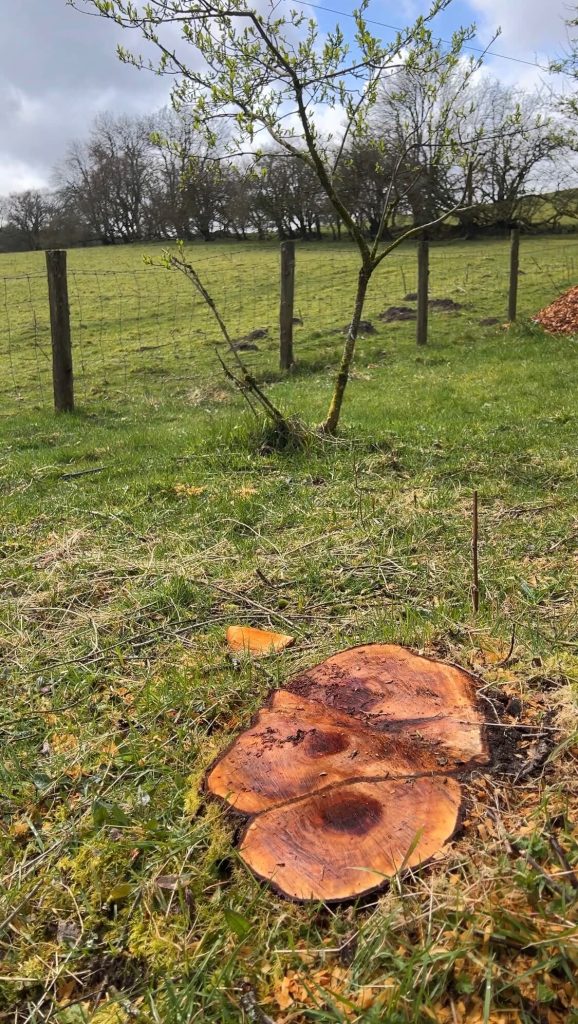
We had some tree surgeons cut down a tree on our property that was in the way of power lines. I felt sad when they had left at what had happened to the tree and this is what prompted me to think about the communication that had been cut between this tree and its network. The irony is that it was cut down because of electrical communication.
When we speak about loss and the space that is left behind, we tend to speak about the sensing of an absence. But I feel like we are also sensing the difference in an unspoken method of communication. This makes me think about the mycorrhizal networks that trees have.
In my imagination I visualise invisible threads that reach out from us and touch into the space between us and those we love and feel safe with. As if we communicate and share information with each other through these threads, like trees do underground.
And when one of us is gone. There is still the transmission of the signal. But nothing comes back.
The feeling of nothing coming back
When we speak about grief we talk about the absence as a loss of presence. It is a loss of a presence. But I think the reason why it feels so hollow and painful is because we are still reaching out for that being, but nothing is coming back. We are transmitting to a space where there is no longer anything receiving our signal. Like a phone that rings and is not answered anymore.
We feel the reaching but no touching.
Sensing the space between us
There is so much going on between us and our environment and the people we are connected to. So much is happening at a non-verbal, sensory level. I find it fascinating that we are potentially sensing more of the space around and between us than we think.
Our nervous system is picking up information from the environment before we have even registered anything cognitively. Stephen Porges labels this ‘neuroception’ (Porges, 2011). Our orienting system deep in the hindbrain is always aware, always orienting us, and our sensorimotor network is coordinating sensations interoceptively and exteroceptively before perception and cognition lead to awareness and attention and thought (Corrigan & Christie-Sands, 2020). But what intrigues me right now is the role that our joint receptors might play in this sensing.
There is a paragraph in J.J. Gibson’s 1966 text ‘The Senses Considered as Perceptual Systems’ (Gibson, 1966) that I cannot stop thinking about. Gibson discusses that our joint receptors read space from all angles projecting outwards from the joints. They read not just our own position in space, but the space around us.
My artistic interpretation of this is to visualise our joints with invisible threads radiating outwards into the space around us, and past our peri-personal boundary.
To me, loss feels like a severing of these threads. As if we are no longer tethered to the mooring of the connection we once had. Our threads are like pieces of rope that once held boats at dock, but now tumble and twist, restlessly reaching in the water.
When we are untethered, the space feels different. It starts to feel bigger and wider and sometimes that can feel unsettling and even scary. We keep reaching until we register that nothing is coming back or until the fear tells us to contract and stop reaching because the space feels scary.
But in this space we can feel many things, not only disconnection or fear.
Vastness and Awe
In moments when we are reaching and sensing space we can also be closer than we think to the feeling of awe. The sense of vastness is one of the elements of awe. Several times in my life I have felt that feeling of overwhelming wonder and elevation. Usually when moving through a beautiful landscape in my car whilst listening to music that has that mixed quality of melancholy and uplift at the same time. This feeling has been the strongest for me in moments where I have also been navigating feelings of loss and isolation.
As Dacher Keltner says in his book about the subject, the sensing of space is a part of this feeling of awe (Keltner, 2023). I feel that the tethering or the container is also important. The sensing of great vastness, but with a container or something to ground us. Something is holding us, whilst also making us feel expanded. For me the container is my car, but it could also be the screen through which you view a beautiful awe-inspiring image or video.
I would love to know whether you have experienced awe, and was it stronger during times of loss or isolation?
I am working on expressing this through sound and moving image as part of my ongoing enquiry into loss and awe through a mechanism I am calling ‘sensory convergence’. I’d love to know what imagery comes to mind for you when you think of things that make you feel awe. Also, have you ever experienced awe during times of loss?
References
Corrigan, F. M., & Christie-Sands, J. (2020). An innate brainstem self-other system involving orienting, affective mutual gaze and the freeze response with retention of awareness: Clinical application of deep brain reorienting. Medical Hypotheses, 136, 109502.
Gibson, J. J. (1966). The Senses Considered as Perceptual Systems. George Allen & Unwin Ltd.
Keltner, D. (2023). Awe: The Transformative Power of Everyday Wonder. Allen Lane.
Porges, S. W. (2011). The Polyvagal Theory: Neurophysiological Foundations of Emotions, Attachment, Communication, and Self-Regulation. W. W. Norton & Company.
Simard, S. (2021). Finding the Mother Tree: Uncovering the Wisdom and Intelligence of the Forest. Allen Lane.